Dale R. - Ohio, USA
Tribute to Arwen
Pattern:
I began with a pattern from the book "Patterns for Theatrical Costumes"
by Katherine Strand Holkeboer (This book has actual costume patterns for
both men and women ranging from the ancient Egypt time period to 1915). The
patterns are on 8-1/2" x 11" pages so they must be enlarged - even for most
doll sizes. The book contains full instructions on how to enlarge the
patterns for human (or elf, hobbit, wizard, etc.!) size using a grid system
- as well as some basic fitting information and other very useful costume
stuff. I highly recommend it.
 For
a doll size pattern I scanned the page and saved it on my hard drive - then
enlarged it to the size I wanted using a photo editing program. (A tutorial
is being prepared showing how to enlarge/shrink a pattern (either from a
book like this or from pattern envelope/instruction pattern piece pictures)
to fit a doll and will include some basic fitting information. A link will
be placed here once the tutorial is complete).
For
a doll size pattern I scanned the page and saved it on my hard drive - then
enlarged it to the size I wanted using a photo editing program. (A tutorial
is being prepared showing how to enlarge/shrink a pattern (either from a
book like this or from pattern envelope/instruction pattern piece pictures)
to fit a doll and will include some basic fitting information. A link will
be placed here once the tutorial is complete).
Note: There are several non-princess seam Medieval-type gown patterns in
this book. I chose a Kirtle gown pattern from the late 15th Century (pg.
156-57 in the book) and I changed the neckline from a square one to a
rounded one.
This is a princess seamed gown and I chose to use it for several personal
reasons........
1) I like the fit that I can get from a princess seamed garment
(especially around the bust line and waist). People who buy fashion
dolls/outfits desire close-fitting garments and even though the "real"
Arwen's gowns fall close to her body without princess seams, this won't
necessarily happen on a doll using a pattern similar to what was used for
Liv Tyler because.... There just isn't enough fabric weight in the garment
(due to the small size) to create the draping that happens on a human.
(This is why I like to use the stretch velvet - the knit has more weight
than
woven velvet so it creates a nice draping around the doll's body).
2) Along with the close fit around the waist, I like lots of fabric
around the bottom of the costume so that I can drape the hem in such a way
to create the illusion of movement (to me part of the beauty of the LOTR
female costumes is the way they move - in the wind, when walking, etc. When
a garment is placed on a doll it remains static.) And since I knew I was
going to be using velvet for 3 of the costumes, I wanted to have
pattern pieces that would follow a straight grainline. I also did not want
each piece to have such a huge flare at the bottom. When there is too much
breadth at the bottom of the garment (e.g., if a full circle is cut all in
one piece) there are areas where the velvet nap doesn't look as "rich"
because the nap actually ends up going in various directions.
After enlarging the pattern to fit the doll, I cut out a "mock-up" of a
knit fabric that had a stretch and draping quality closely matching the
stretch velvet I was using for the actual garment.
Note: Whenever I do a mock-up garment I try to use a fabric that will
react closely to the actual fabric I will be using for the final garment
(e.g. an inexpensive knit if I'm going to be using a knit velvet, an
inexpensive satin/taffeta if I am going to be making the final garment out
of a satin or taffeta, etc.). I do this instead of using muslin - purely a
personal preference as I have had problems using muslin for the mock-up when
it doesn't have the same qualities as the fabric I am going to use for the
final item. I knew I would be using a knit for all of these costumes - and
knit fabrics require a different fit than a woven. When working on doll
clothes, the tolerances for error or a mis-fit are very small - 1/16" off on
each seam can cause the garment to fit very poorly. Once the mock-up was
fitted to the doll I marked all of the seam lines and took it apart to
create a pattern.
Trims:
 Finding
trims in proper scale for doll costumes is always a challenge - and these
came from many different sources. *The braided trim (it is coiled metal and
comes from India) around the neckline of the Requiem & Dying dress came from
a seller on Ebay - HeritageTrading The beaded ribbon trim on the
sleeves of the Mourning dress is also from this seller- I added cream pearl
strand trim above and below the ribbon.
Finding
trims in proper scale for doll costumes is always a challenge - and these
came from many different sources. *The braided trim (it is coiled metal and
comes from India) around the neckline of the Requiem & Dying dress came from
a seller on Ebay - HeritageTrading The beaded ribbon trim on the
sleeves of the Mourning dress is also from this seller- I added cream pearl
strand trim above and below the ribbon.
*The various other trims came from my "stash":
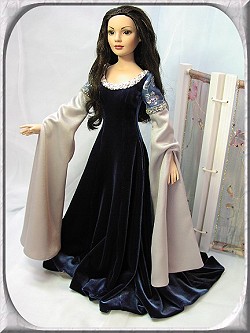
The sheer sequin/beaded upper sleeves of the Requiem gown is a beaded
organza fabric- it was a pale grey color. I used a Prisma pen to color the
fabric (and the doll's eyes) blue. I found the beaded ribbon in a
bridal section of a fabric shop in Colorado - it is narrow (3/8") and was
perfect for the Requiem upper sleeve band.
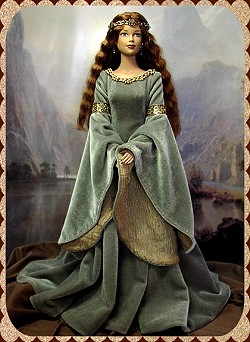
The white trim on the Coronation gown upper sleeves was a combination of
four different trims. The two vertical trims were made up of cording and
pearls - I added pale yellow beading in between the circles and around the
trim. The iridescent pearl trim comes as a strand and can be bought by the
yard (it's the same as the cream pearl trim I used on the Mourning gown) -
this was placed in a line between the corded trims. I edged the bottom of
the upper sleeves with yet another cord/pearl trim that has a "wave" design
and accented it with the pale yellow beads. The neckline trim was the same
as the trim used on the center of the upper sleeves -
with yellow beads added and the pearl strand placed above and below the
trim.
Gold "buttons" down the front of the Mourning gown are small gold beads.
Mourning gown neckline trim is a red/gold braid with a cream pearl strand
added below it. I placed the red satin "V" over the trim and hand stitched
it in place.
Construction details
The dresses are completely lined with nude tricot. This fabric was used
because it is a knit (to work with the knit velvet) and also because colors
from fabrics tend to leach into the doll vinyl and leave stains. The nude
lining provides a neutral color resting against the doll.
I completely machine-stitched the lining to the dress along the hemline
(leaving a 4" opening in the center back lining seam for turning) - making
the lining 1/4" shorter than the dress. This allowed for a lovely "drapy"
hem without any sort of hem stitching showing.
All seam allowances are 1/4" - anything larger is hard to work with on
the small pattern pieces.
Coronation headpiece was made using silver wire, a jewelry piece (for the
back) and lot of beads! I drew out a template of the design on paper and
placed this on a small cork bulletin board - placing a row of pins along the
design lines. I then bent the wire along the pins/lines to get the shape I
wanted. Small pieces of wire were bent around crucial points to hold
the crown curved wires together - and jewelry glue was used to reinforce
these places.
Mourning gown "crown" was made from Art Emboss light brass color sheet
(bought at Michael's). I used the embossing stick that comes with this to
"etch" the design details. I cut a strip 3 times the width I wanted - etched
a line down the length in two places and folded each over so that the band
part is actually 3 thicknesses. For the front piece I cut the shape out of
cardboard - then out of the metal sheet (with an extension added all
around). I etched the piece with the "Gondor design" and glued the metal to
the cardboard, clipped the extension every 1/4" or so all around, and bent
the extension pieces to the back of the cardboard. The cardboard area was
painted on the back (to blend the color) and the piece was glued to the
front of the band.
The veil is black chiffon cut in a rectangle with curved corners - edged
with a tiny machine zig-zag stitch. I folded a 1/2" hem, hand basted the hem
in place and stitched the zig-zag along the folded edge. The excess hem was
trimmed away - carefully - with small curved scissors! The veil is held in
place with the headpiece.
Sleeves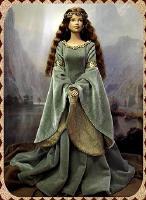
Coronation gown: Fitted upper sleeve with 1/2 circle cut used on the
lower sleeve- made of two layers of chiffon (green and cream/ecru)
that have a rolled-hem stitch around outer edge (done on a serger).
Requiem gown: self fabric-lined lower sleeves, tube shaped with a flare
at the bottom, slit up the front (elastic tacked to the inside of sleeve at
the
top of the slit to hold it onto the doll's wrist).
Mourning & Dying dress: lower sleeves are the 1/2 circle cut again, both
fully lined. The Dying dress sleeve also has a piece of elastic attached to
the inside of the sleeve to hold it in place at the doll's wrist so the
sleeve can drape nicely on the doll's arm.
Elf Ears
Elf ears were put onto the Coronation Gown Arwen doll using a product
that is made for model airplane/car hobbyists - Squadron White Putty. It
comes in a tube, air dries hard and can be sanded. I simply used a toothpick
to build the elf ear shape onto the top of the doll's ears - using pictures
of Arwen's ears from the movies as a guide. I then sanded the addition and
painted (using acrylic paint) the whole ear to blend in with the color of
the vinyl. I have two more dolls with elf ears added "standing by" for when
I have time to do the Chase and Bridge costumes!
See larger pictures and more on Dale's web site:
Arwen Homage,
Eowyn/Arwen Combo

Our Cloak Closet | Cloak Closet 2 | Banners | Banners 2 | Dolls 'n' More | Dolls 'n' More 2
Home | Up | Dale | Denisa | Heidi's Examples | Ron & Diane's Examples
This page was last updated
11/21/09